
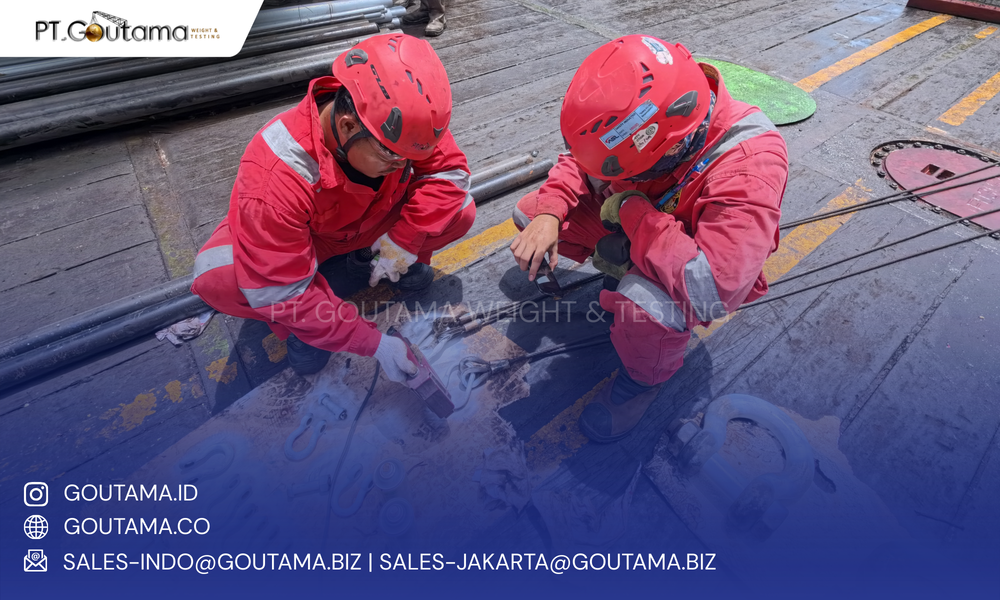
Inspection Procedure for Shackles
In lifting and rigging activities, shackles are critical components that serve as connectors between slings, wire ropes, chains, and loads. Inspections are carried out visually and dimensionally, and are recorded as part of work safety documentation. Therefore, understanding shackle inspection procedures is mandatory before the equipment is used
What is a Shackle?
A shackle is a U-shaped (bow shackle) or D-shaped (D shackle) rigging device equipped with a pin as a lock. Shackles are designed to withstand tensile loads and are used in various lifting, load testing, and heavy equipment installation applications. Each shackle has a Working Load Limit (WLL) specified by the manufacturer, which must be adhered to during use.
Why Do Shackles Need to Be Inspected?
Shackle inspections aim to ensure that the equipment is still in good working condition and safe to use. Shackles that are worn, deformed, or damaged can lose their lifting capacity significantly.
Without proper inspection, the risk of lifting failure increases, especially in jobs with heavy loads or demanding working conditions.
Inspection Standards for Shackles
In general, shackle inspections refer to manufacturer standards, international standards, and internal company procedures. The following are the procedures for conducting shackle inspections
1. Inspection Preparation
Before conducting the inspection, ensure that the shackle is free of dirt, oil, or rust that could interfere with the inspection process. Identify the shackle specifications, including the type, size, and WLL based on the markings on the shackle body.
2. Visual Inspection
Conduct a thorough visual inspection of the body and pin shackle to detect Cracks, Excessive corrosion, Deformation or change in shape, Damaged pin threads, Non-compliant or non-original pins. If visual damage is found, the shackle must be immediately separated and not used.
3. Dimension Inspection
Measure the diameter of the pin and body shackle to ensure that there is no reduction in dimensions due to wear. A reduction in size that exceeds the manufacturer’s tolerance is an indication that the shackle is no longer suitable for use.
4. Pin Function Inspection
Ensure that the pin can be installed and removed properly, and is fully engaged when in use. A pin that is stuck or cannot lock properly has the potential to cause lifting failure.
5. Evaluation and Marking
After the inspection is complete, evaluate the results. Shackles that pass inspection can be marked as serviceable, while shackles that do not meet the criteria must be isolated or removed from operation.
The Importance of Using Certified and Inspected Shackles
Using shackles that have undergone inspection and certification processes guarantees that the equipment meets safety and technical standards. This is especially important for load testing, heavy lifting, and high-risk industrial projects.
Goutama Weight & Testing provides shackles with capacities up to 150 tons for various industrial rigging and load testing needs.
Contact us now for safe, reliable shackle rental solutions supported by a team of experienced professionals.
📩sales-indo@goutama.biz | sales-jakarta@goutama.biz
📞0811-6932-011 | 0811-169-631
 English
  Indonesian