
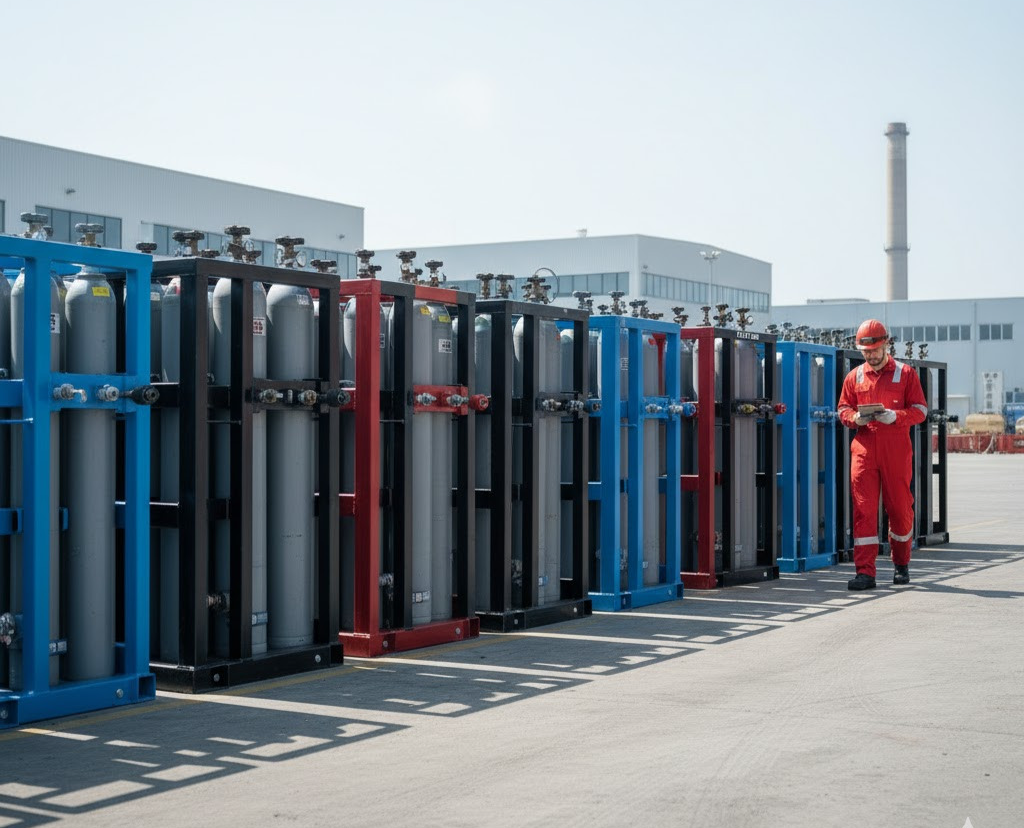
Gas Racks Load Testing for Offshore Operations
Before deployment, every gas rack must undergo load testing for offshore equipment to ensure it meets the required safety and structural integrity standards. Neglecting this step can lead to severe accidents, equipment damage, or even endanger human lives offshore.
Why Gas Racks Require Load Testing Before Offshore Deployment
Gas racks are designed to carry high-pressure gas cylinders used for welding, cutting, and other offshore maintenance tasks. These racks are subjected to constant lifting, vibration, and exposure to seawater—all of which can weaken their structure over time. Performing load testing for offshore equipment verifies that the gas rack can safely handle its intended load capacity, ensuring it remains reliable even under extreme operational stress including:
- Confirming load-bearing capacity under proof loads.
- Detecting structural weaknesses such as cracks, corrosion, or weld defects.
- Ensuring compliance with offshore safety standards like DNV-ST-E271 or BS EN 12079.
The Technical Process of Load Testing for Offshore Equipment
1. Pre-Test Inspection
Before the test, inspectors perform a visual and dimensional check of the gas rack to verify identification plates, lifting points, and weld condition.
2. Proof Load Application
The rack is connected to a calibrated load cell and lifting device (such as a crane) and loaded to a proof load.
3. Structural and NDT Examination
After the load is applied, the rack is inspected for deflection, weld cracks, and joint separation.
4. Certification and Documentation
Once the gas rack passes the test, it receives a Load Test Certificate along with inspection reports and traceability documents—proof that it is fit for offshore use.
Standards and Regulations for Offshore Load Testing
Compliance with recognized international standards is essential in offshore logistics. The most common references for load testing for offshore equipment include:
- DNV-ST-E271: Offshore Containers and Portable Units
- BS EN 12079: Offshore containers and lifting sets
- ASME B30: General lifting device safety
- API RP 2A-WSD: Structural integrity for offshore installations
Conclusion: Offshore Safety Begins on Shore
Every offshore operation starts with preparation on land. By conducting load testing for offshore equipment—especially for gas racks—companies can ensure safe, compliant, and reliable lifting performance in the field.
Proper testing is not just a legal requirement—it’s a proactive investment in operational excellence, worker safety, and client confidence.
If you’re looking for a trusted and certified partner for gas rack load testing,
Goutama Weight & Testing provides professional offshore load testing services, including proof load tests, NDT inspections, and certification according to DNV and international standards.
📩sales-indo@goutama.biz | sales-jakarta@goutama.biz
📞0811-6932-011 | 0811-169-631
 Indonesian
  English