
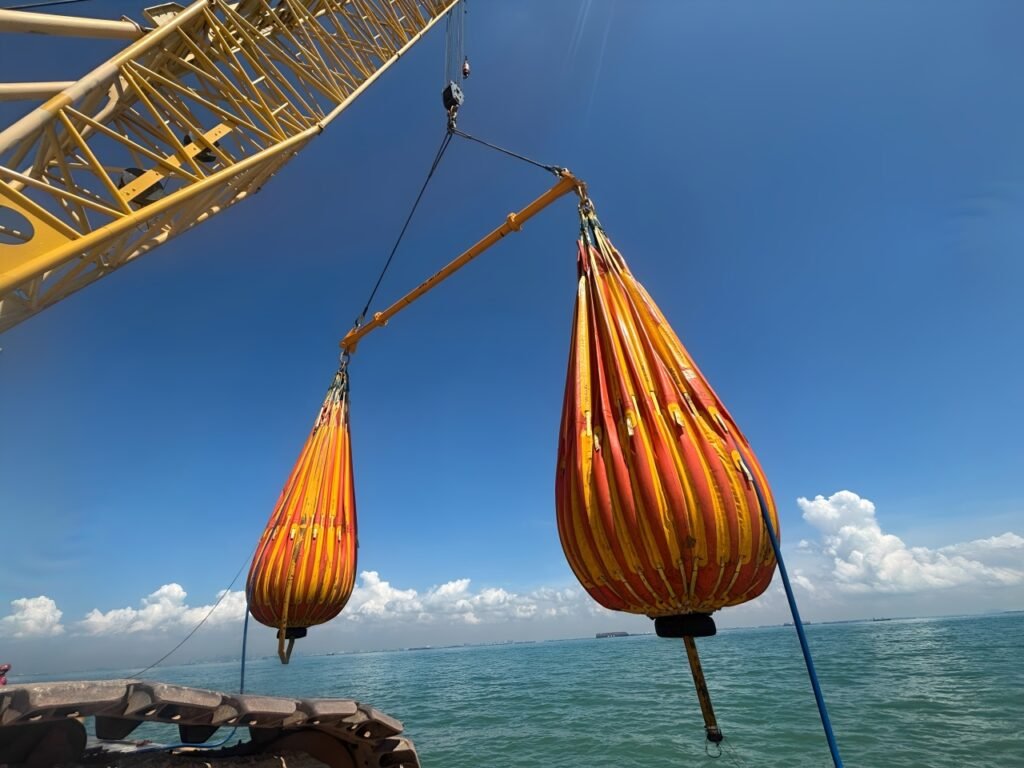
Is Your Spreader Beam Truly Ready to Lift Loads?
Imagine this scenario: a lifting operation is underway at a port, and the spreader beam that is the backbone of the lift shows signs of deformation. As a result, operations are halted, time is wasted, and safety risks increase.
Problems like this often arise not because of poor design, but because of the absence of periodic load testing to prove the integrity of the lifting equipment.
What is a Spreader Beam and Why is Load Testing Necessary?
A spreader beam is an important component in ship lifting operations, used to distribute the load so that the lifting force is evenly distributed and deformation at the lifting point is avoided.
In the maritime industry, Spreader Beam Load Testing Services for Marine Lifting Operations are an important step to ensure that every lifting device is truly usable, safe, and meets international standards such as DNV 2.7-1, ABS, or Lloyd’s Register.
However, over time and with intensive use, these components can experience fatigue, micro cracks, or structural distortion. This is why load testing is necessary —to ensure that the structure can still safely withstand its working load limit (SWL).
Technical Steps in the Spreader Beam Load Testing Process
1. Inspection & Preparation: the technical team conducts a visual inspection to check for cracks, corrosion, and the condition of the pins or shackles. Then, the measuring device (load cell) and test weight are calibrated to ensure accurate results.
2. Load Testing: The load is applied gradually, usually starting from 25%, 50%, 75%, until it reaches 100–125% of the Safe Working Load (SWL).
3. Holding test: After the maximum load is reached, a holding period is carried out for a certain duration (generally 10–15 minutes). The purpose is to ensure that there is no reduction in strength or permanent deformation.
4. Unloading & Inspection: After the load is removed, technicians conduct a post-test inspection to check whether the structure has returned to its original position without cracks or excessive bending. The results will be compared with the tolerances allowed by the classification standards.
Standards and Certifications Used
In the maritime world, load testing spreader beam must refer to international standards so that the results are accepted by classification bodies and port authorities. Some of these are:
- DNV 2.7-1 – for offshore containers and lifting equipment.
- Lloyd’s Register (LR) – ensures the quality and safety of lifting equipment.
- ABS (American Bureau of Shipping) – verifies the integrity of equipment in the maritime sector.
- BS EN 13155 – European standard for lifting beams and spreaders.
By following these standards, the test results are not only administrative in nature, but also provide a guarantee of actual performance in the field.
Ensure Your Spreader Beam is Tested and Safe for Maritime Operations
Looking for a way to make sure your spreader beams meet international safety standards?
Goutama Weight & Testing is here to help with accurate, certified, and efficient Spreader Beam Load Testing Services for Marine Lifting Operations.
➡️ Contact Goutama Weight & Testing today to schedule regular load testing and make sure every lifting operation you do is safe and reliable.
📩sales-indo@goutama.biz | sales-jakarta@goutama.biz
📞0811-6932-011 | 0811-169-631
 English
  Indonesian