
Types of Crane: Definition, Functional Differences, and the Importance of Load Testing for Safety
Introduction
Cranes are critical lifting machines used across construction, manufacturing, logistics, marine, offshore, and industrial environments. Designed to move, lift, and position heavy loads, cranes must operate with a high degree of precision and reliability.
What Is A Crane
A crane is a mechanical lifting device equipped with hoists, wire ropes, sheaves, and structural lifting components that enable vertical and horizontal load movement. Cranes can be fixed, semi-mobile, or fully mobile, depending on operational needs.
Types of Cranes and Their Differences
- Overhead crane: Often used in factories and warehouses, overhead cranes run on elevated runways.
- Gantry crane: Similar to an overhead crane but supported by legs instead of runway beams.
- Mobile crane: Mounted on a wheeled vehicle and designed for flexibility, best for construction sites, road works, general lifting tasks.
- Tower crane: Tall, fixed cranes commonly seen on high-rise construction projects. It has wide working radius, excellent height capability, stable foundation.
- Crawler crane: Equipped with tracks (crawlers) instead of wheels. It has superior stability, no need for outriggers, and excellent for heavy loads.
- Offshore crane: Designed for lifting operations on oil rigs, vessels, and offshore platforms. This type of crane is weather-resistant, dynamic load capabilities, anti-corrosion design.
How to Ensure Cranes Operate Safely
- Routine Visual Inspection: Inspect hooks, wire ropes, sheaves, brakes, limit switches, and structural parts.
- Preventive Maintenance: Lubrication, alignment, electrical system checks, and component replacement reduce mechanical failure.
- Functional Safety Checks: Testing braking performance, movement control, and emergency stop systems.
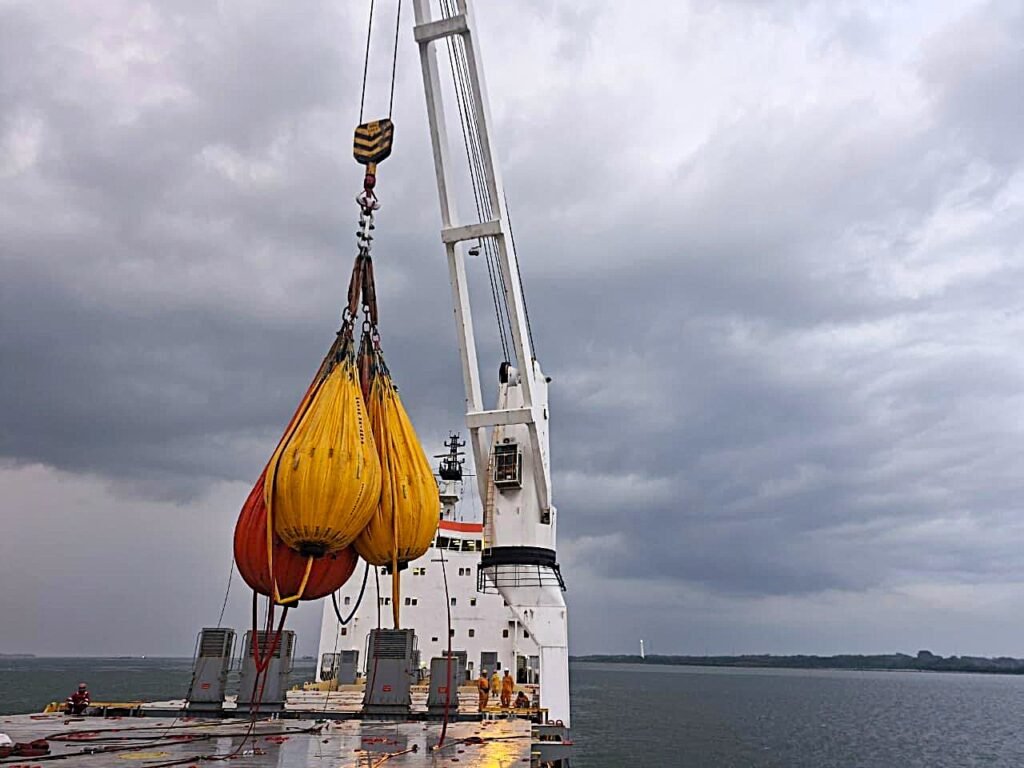
- Load Test (The Most Critical Step): Crane load testing reenacts real-world lifting scenarios by applying controlled loads using water bags, test weights, or load cells. It verifies whether the crane can safely lift its rated load without deformation, structural failure, or mechanical malfunction.
Conclusion
Cranes come in many types—each designed for specific environments, lifting capacities, and operational requirements. Regardless of whether it’s an overhead crane, mobile crane, offshore crane, or gantry crane, one rule remains the same: every crane must be tested, inspected, and verified for safety.
Load testing is the most reliable way to ensure cranes perform safely under real-world load pressures
Ensure every crane in your operation meets safety and compliance standards.
Contact Goutama Weight & Testing today for certified, reliable crane load testing.
📩sales-indo@goutama.biz | sales-jakarta@goutama.biz
📞0811-6932-011 | 0811-169-631
 English
  Indonesian