Why It Is Important for the Manufacturing Industry
In the manufacturing industry, forklift are vital tools in logistics and material handling activities. However, did you know that every forklift must have a load testing certificate?
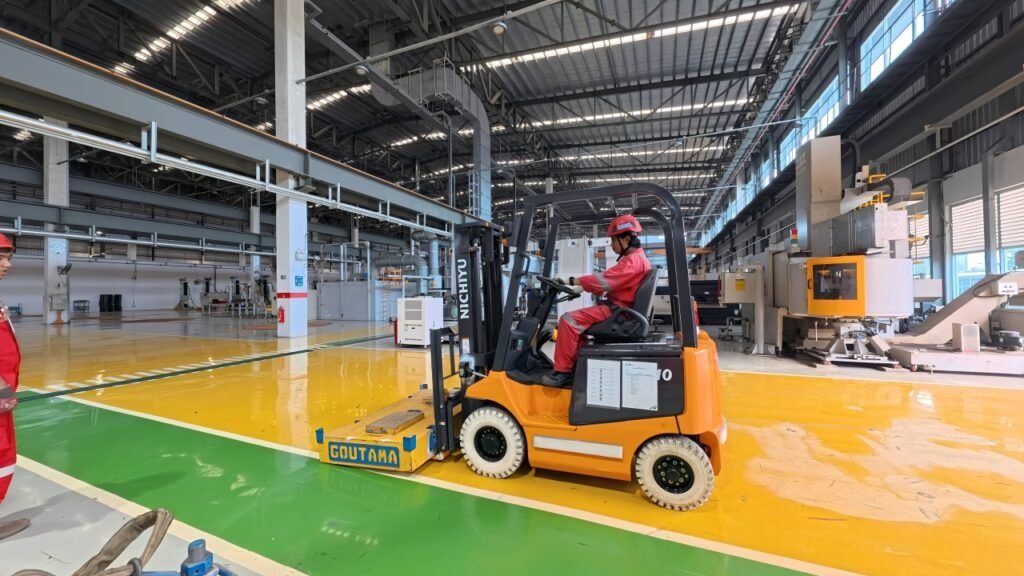
Forklift load testing certification is a technical inspection process conducted to ensure that forklifts are capable of lifting and holding loads according to their nominal capacity without deformation or damage.
This test is carried out by competent companies that have official calibration and certification equipment, such as Goutama Weight & Testing, which has extensive experience in load testing and lifting equipment certification.
Purpose and Benefits of Forklift Load Testing
1. Ensuring Operator and Work Environment Safety
Forklift that are not load tested are at risk of lifting failure, causing accidents, injuries, or damage to assets. Load testing ensures that forklift operate safely.
2. Meeting Safety Standards and Regulations
According to work safety regulations, every lifting device must undergo inspection and certification of operational feasibility. A load test certificate is proof that the forklift meets K3 (Occupational Safety and Health) standards.
3. Reducing Unexpected Maintenance Costs
With periodic load testing, potential damage to the forklift’s hydraulic system, chains, or mast can be detected early before it incurs significant costs.
4. Increases Production Efficiency
Tested and certified forklift work more stably and efficiently. This helps maintain a smooth production chain without technical disruptions.
How is the Forklift Load Testing Certification Process Conducted?
The forklift load testing certification process is conducted through several technical stages involving calibrated testing equipment and certified experts:
1. Initial Visual Inspection: Assessing the physical condition of the forklift, such as tires, mast, chains, and hydraulic system.
2. Determination of Test Load Capacity: The load tested is usually 110–125% of the nominal capacity to ensure higher safety.
3. Implementation of Static and Dynamic Load Tests
- Static test: the forklift is lifted with a fixed load in a stationary position.
- Dynamic test: the forklift is operated with a load to assess the stability and performance of the lifting system.
4. Evaluation and Documentation of Test Results: The test results are recorded and evaluated to determine whether the forklift is fit for use.
5. Issuance of Load Test Certificate: If the test results meet the standards, the testing agency will issue a forklift load testing certificate as official proof of the equipment’s suitability.
Make sure Your Forklift is Safety Now!
Ensure your forklift is safe and certified by a professional company. Contact PT Goutama Weight & Testing to perform periodic forklift load tests and obtain an officially recognized certificate of operational suitability.
📩sales-indo@goutama.biz | sales-jakarta@goutama.biz
📞0811-6932-011 | 0811-169-631
 Indonesian
  English