What is a Dye Penetrant Test? Understanding NDT Methods for Detecting Material Cracks
Dye Penetrant Test, also known as Liquid Penetrant Inspection (LPI), is a Non-Destructive Testing (NDT) method used to detect discontinuities or defects that are open to the surface in non-porous materials. This method is widely used, especially in industries with stainless steel or non-ferrous equipment.
This article will provide a simple explanation of the Dye Penetrant Test, including its definition, differences from other NDT methods, and the procedures for conducting it.
Differences Between Dye Penetrant Testing and Other NDT Methods
Although both aim to conduct safety inspections, DPT has different characteristics compared to other methods, such as:
1. Dye Penetrant Test (DPT) vs Magnetic Particle Inspection (MPI)
Unlike MPI, which uses magnetic fields for ferromagnetic metals, Dye Penetrant Testing uses colored/fluorescent liquids for non-porous materials. The MPI method is more effective for detecting minor subsurface defects, while dye penetrant testing is more effective for surface defects.
2. Dye Penetrant Test vs Ultrasonic Testing (UT)
Ultrasonic Testing uses sound waves to detect defects inside materials (internal). In contrast, DPT focuses exclusively on leaks or cracks that reach the outer surface.
Standard Procedure for Conducting Inspections Using the Dye Penetrant Test Method
1. Surface Cleaning (Pre-Cleaning)
Clean the surface of dust or other dirt using a cleaner so that the penetrant liquid can penetrate perfectly into the defective or damaged parts.
2. Application of Penetrant
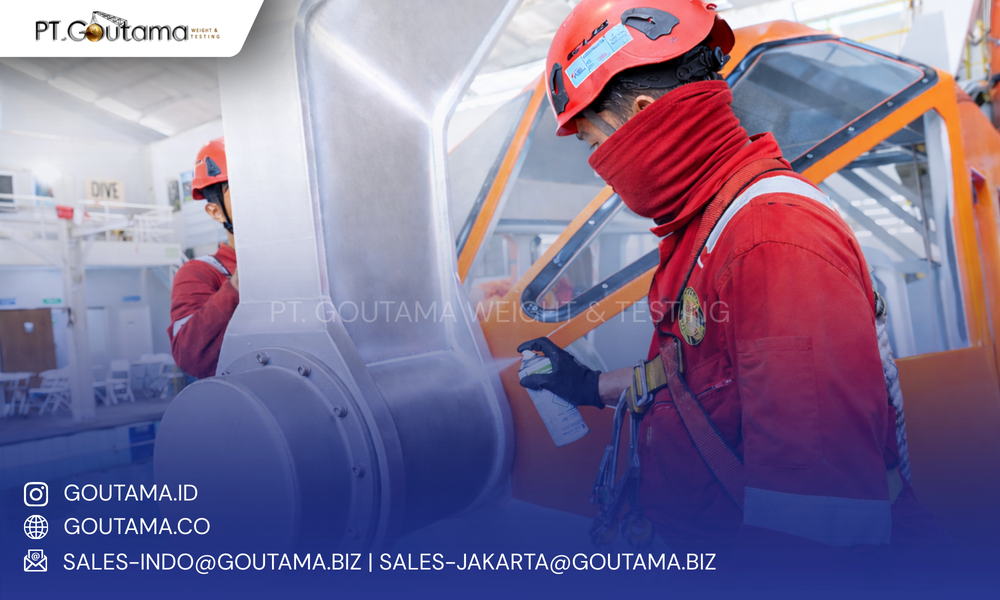
The penetrant is sprayed or applied and left for a certain amount of time (dwell time) until it completely penetrates the material.
3. Cleaning Penetrant Residue
Excess penetrant fluid is carefully cleaned using a clean cloth moistened with solvent. After that, it is left to dry through normal evaporation.
4. Developer Application
The developer fluid is applied to draw the penetrant out of the cracks, creating a clear color contrast after being left for approximately 5-10 minutes.
5. Inspection
The type and size of defects are determined by observing the parts that show signs of defects (stains or colored lines) and then documenting them for inclusion in the inspection report.
6. Post Cleaning
The tested material is cleaned using a cleaner and then dried using a cloth.
Entrust Your NDT Inspections to the Experts
Goutama Weight & Testing is here as your trusted partner for Dye Penetrant Test Indonesia needs. We are supported by professional experts and certified equipment to provide accurate, fast, and technically compliant NDT inspection results.
Contact our team now for professional NDT inspection consultation and services for your project!
📩sales-indo@goutama.biz | sales-jakarta@goutama.biz
📞0811-6932-011 | 0811-169-631
 Indonesian
  English